

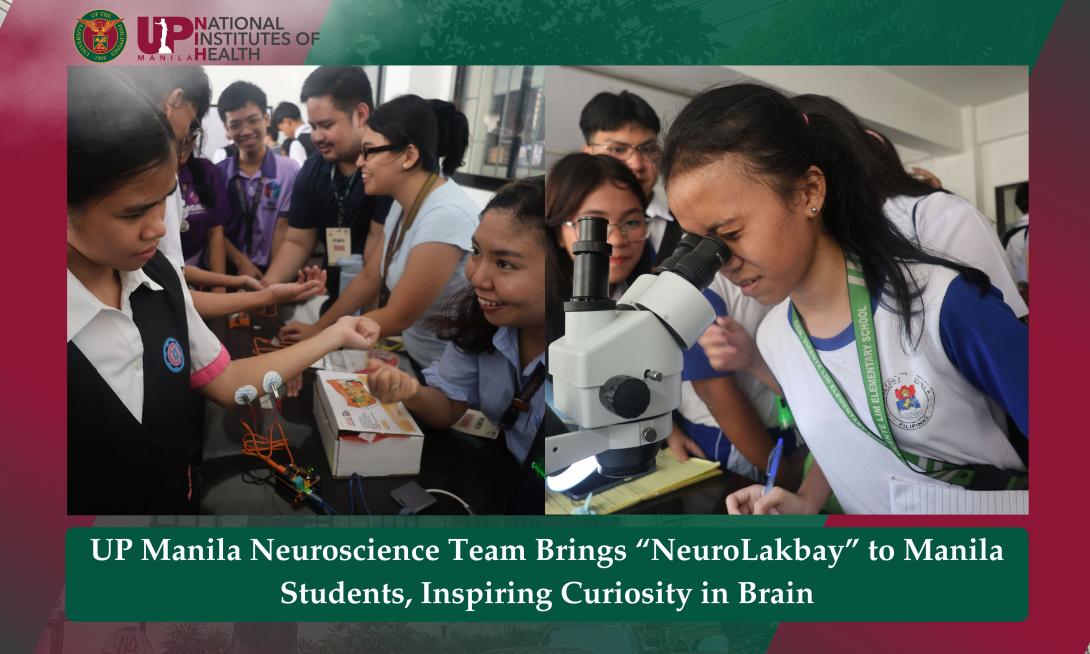
The Behavioral Neuroscience Laboratory of the National Institutes of Health, University of the Philippines Manila (NIH-UPM) recently brought neuroscience closer to young minds through NeuroLakbay, a brain awareness activity held at Rajah Soliman Science and Technology High School in Binondo, Manila.
Led by Dr. Rohani Cena-Navarro, Research Faculty of Institute of Molecular Biology, Director of the NIH National Center of Biosafety and Biosecurity and Program Leader of the Department of Science and Technology (DOST)-funded project “Novel Approaches to Treatment of Addiction and Depression (NATAD) using Animal Models,” the event aimed to introduce high school students to the wonders of the human brain and mental health science.
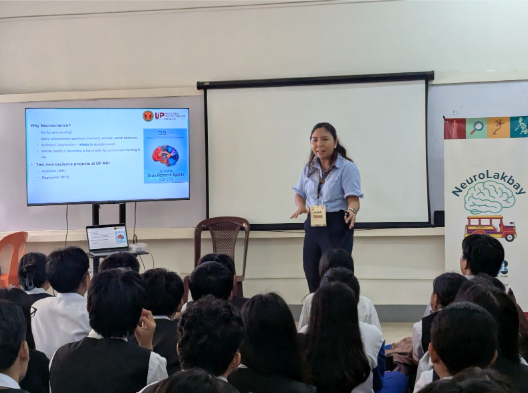
Through hands-on demonstrations, students from the school’s STEM strand and selected pupils from Pedro Guevarra Elementary School explored how the brain influences thought, emotion, and behavior. Activities included Brain Anatomy and Microscopy, where participants examined and compared healthy and chemically exposed mouse brains; Electromyography (EMG), which visualized how brain signals control muscle movement; and EEG and ECG demonstrations, allowing students to observe brain waves and heart rhythms in real time. The session concluded with an Optical Illusion booth that showcased how the brain interprets — and sometimes tricks — our perception.
“Our country needs more neuroscientists,” shared Dr. Cena-Navarro. “Through NeuroLakbay, we hope to inspire students to see neuroscience as a field where they can make meaningful contributions to understanding brain function, behavior, and mental health.”
Following the successful launch in Manila, NeuroLakbay will soon be replicated at four universities across Luzon, Visayas, and Mindanao starting next year, with continued funding support from the DOST.
Dr. Gregory J. Quirk, co-investigator of the NATAD Project, also expressed gratitude to DOST and the Philippine Council for Health Research and Development (PCHRD) for supporting initiatives that promote brain and mental health research in the country.
The activity marks another step in UP Manila NIH’s mission to promote science education and encourage the next generation of Filipino researchers to explore the complexities of the brain.
📖 Read the full DOST-PCHRD feature:
Students Gain Hands-on Experience in Neurosciences, Sparking Curiosity in Brain and Mental Health